The sum of all numbers between 1 and n can be shown as:
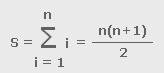 (1)
(1)where i, n are members of N. We can build the sequence of numbers in which the sum of any two adjacent members can be shown in the form of the formula (1). Let's have the second rule that says: the sum of the first and the second member is equal to b(b+1)/2, the sum of the second and the third member is (b+1)(b+2)/2, the sum of the third and the fourth member is (b+2)(b+3)/2 etc. If the first number of the sequence is a1, then we can calculate all other members:
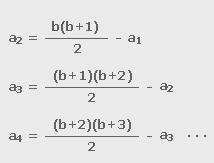 (2)
(2)All members of the sequence must be positive numbers.
Now we can build our fist sequence. If we define that the first member is a1=5, (or a=5) and that the sum of the first two members is equal to 7(7+1)/2 -> b=7, we can write down the first 20 members:
5 23 13 32 23 43 35 56 49 71 65 88 83 107 103 128 125 151 149 176
By extracting the last digit of every member, we get new sequence:
5 3 3 2 3 3 5 6 9 1 5 8 3 7 3 8 5 1 9 6
To see the formation of these numbers in graphical view, we put them in the graph shown below:
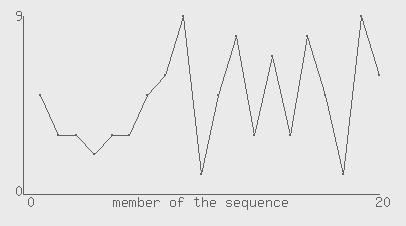
The graph is devided in two simetrical parts: the left part consists of 7 members and the right consists of 13 members. How many members form each simetrical part, depends on number b. The right part has
k2 = 2b - 1 = 13 members and the left k1 = 20 - k2 = 7 members. This graph repets every 20 members.
We can verify formulas for calculating k1 and k2 with the new sequence: a=5, b=6.
5 16 12 24 21 34 32 46 45 60 60 76 77 94 96 114 117 136 140 160
5 6 2 4 1 4 2 6 5 0 0 6 7 4 6 4 7 6 0 0
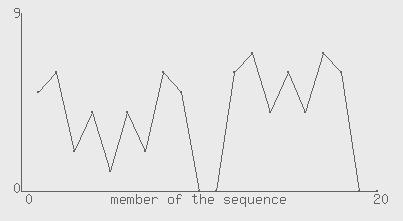
k1=9
k2=11
Here you can get the graph for the parameters a and b that you define.
If the sum S is known, we can determine number n using formula (1):
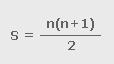
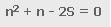 (3)
(3)Roots of this quadratic equation are:
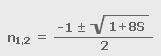 (4)
(4)Since we can accept only positive number as solution, we will exclude negative root:
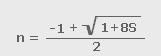 (4.1)
(4.1)For example, for S=78, n is equal to:

Step 2
Graphing
Contact